CHEETAH Mission

The CHEETAH Center was established to study the structural biology of HIV/Host interactions involved in HIV trafficking, assembly, and egress.  We are one of three NIH-funded Centers that study the Structural Biology of HIV/Host interactions.  The nucleus of our Center arose through a merger of two groups; one at Scripps (Gerace, Millar, Williamson), and another at Utah (Hill, Kay, Sundquist) and Caltech (Jensen) that had previously participated in the NIGMS P01 Program on Structural Biology of AIDS-related Proteins (GM-02-004).  This was a natural merger because there were already strong ties between our groups, virus/host interactions were already a major focus of both P01 Programs, and there was excellent complementarity between the two groups, both in terms of research focus and technical expertise.  This group was then strengthened further by the addition of investigators with expertise in tracking viral particles in living cells (Tom Hope, Northwestern), using biosensors and other biophysical techniques to study protein-protein interactions (David Myszka, Utah), protein structure determination using small angle X-ray and neutron scattering (Jill Trewhella, Utah/University of Sydney), the application of computational methods to study protein motions and assemblies (Greg Voth, Utah), and protein structure determination using EM crystallography (Mark Yeager, Scripps).

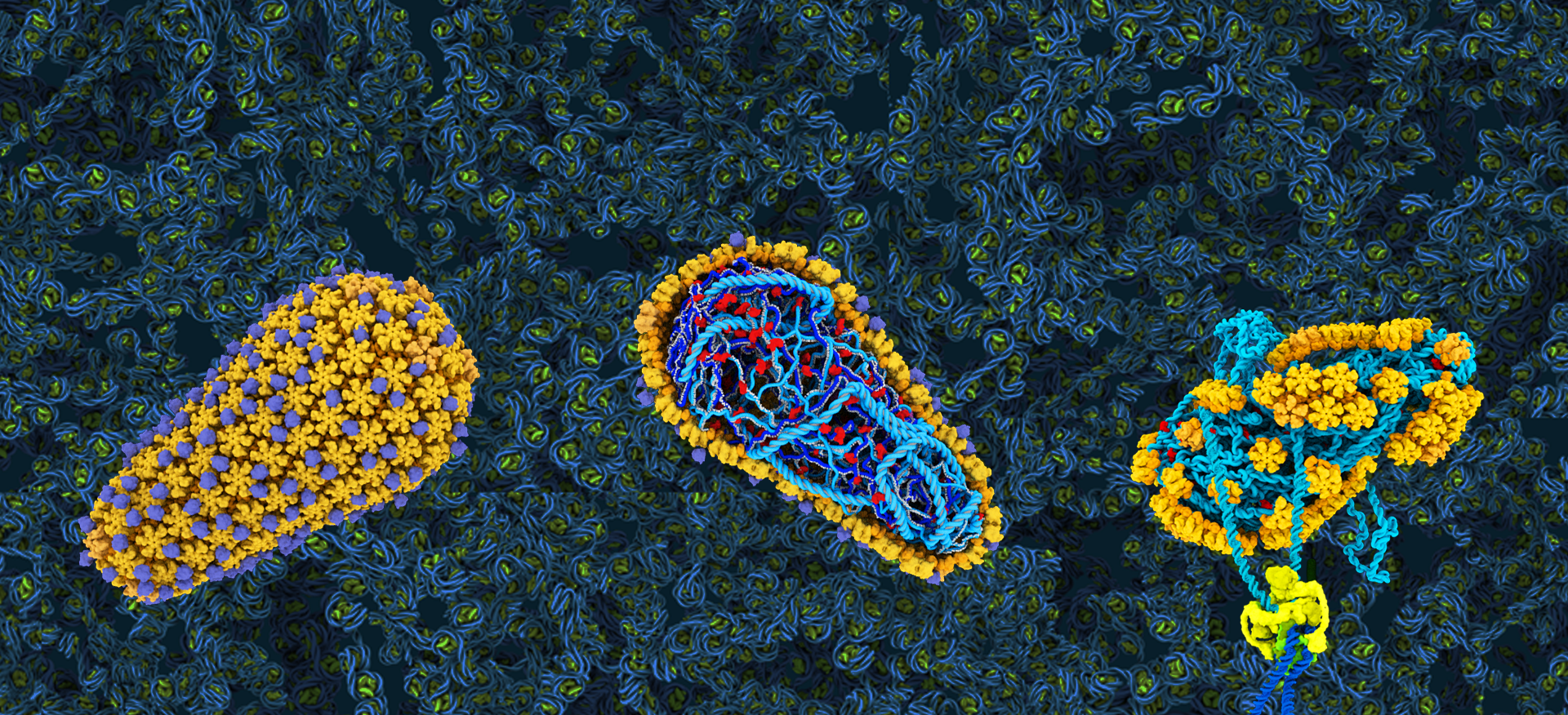
Research in our Center is focused in four areas: 1) Viral RNA and Gag Trafficking, 2) Virus Budding, 3) Virus Structure, and 4) Early Events and TRIM5α Restriction.  Our studies are designed to define the molecular basis for Rev-dependent nuclear export, reveal the structures of virus/host complexes and enzymes that facilitate virus budding, and reconstruct the immature and mature HIV virions. Collaborative interactions are extending our research to include structural studies of TRIM5α restriction, the infectivity enhancement of HIV Nef, and host factors involved in the early stages of viral replication. 

We are also developing and applying new computational and experimental methods for analyzing virus/host complexes, imaging how they traffic in the cell, studying how they function as molecular machines, and inhibiting their functions. We anticipate that this work will help lay the groundwork for new antiviral strategies and will also help develop HIV into a leading model system for studying how a human virus interacts with its cellular host.

TSG101 UEV Complexes

TSG101 UEV Complexes with the HIV-1 p6Gag PTAP Late Domain (purple) and Ubiquitin (green).  This composite model also shows the ubiquitin Ile-44 side chain (yellow) and ordered water molecules (red).  The model was derived from NMR and crystallographic studies in the Sundquist and Hill laboratories.

Email Webmaster